Apr 21, 2026
Top 7 Easiest Martial Art To Learn

Key Takeaways
Boxing is the most commonly recommended starting point for beginners because it covers only four core punches and basic footwork, so early progress feels fast and obvious.
The easiest martial art for you depends on whether you want to spar, train at home, compete, or focus on self-defense. Each goal points to a different answer.
Judo and karate tend to have the most accessible black belt timelines for consistent adult beginners.
Krav Maga and boxing get beginners to usable self-defense skills faster than most other styles.
A good instructor and a structured beginner program matter more than which style you pick.
There is no single easiest martial art to learn. The honest answer depends on what you want out of training.
Someone who wants to get in shape and learn to punch has a different answer than someone who wants practical self-defense, a competitive outlet, or a black belt to work toward. This guide breaks it down by goal so you can actually land on the right choice, not just the most popular one.
1. Boxing
Boxing is built around four punches: the jab, cross, hook, and uppercut. Add footwork and head movement, and that is essentially the whole game at the beginner level. There are no throws to learn, no ground positions to memorize, and no weapons or gi required. You can start building real combinations within a few sessions.
It is also one of the best conditioning sports you can do. Bag work, pad work, and sparring all push your cardio hard. If you want fast feedback, visible improvement, and a workout that leaves nothing in the tank, boxing is hard to beat as a starting point.
Good for
Fitness, striking fundamentals, confidence
Contact level
Scalable. Most gyms keep beginners on bags and pads for weeks before introducing sparring.
Equipment needed
Gloves, hand wraps, a bag or gym membership
2. Karate
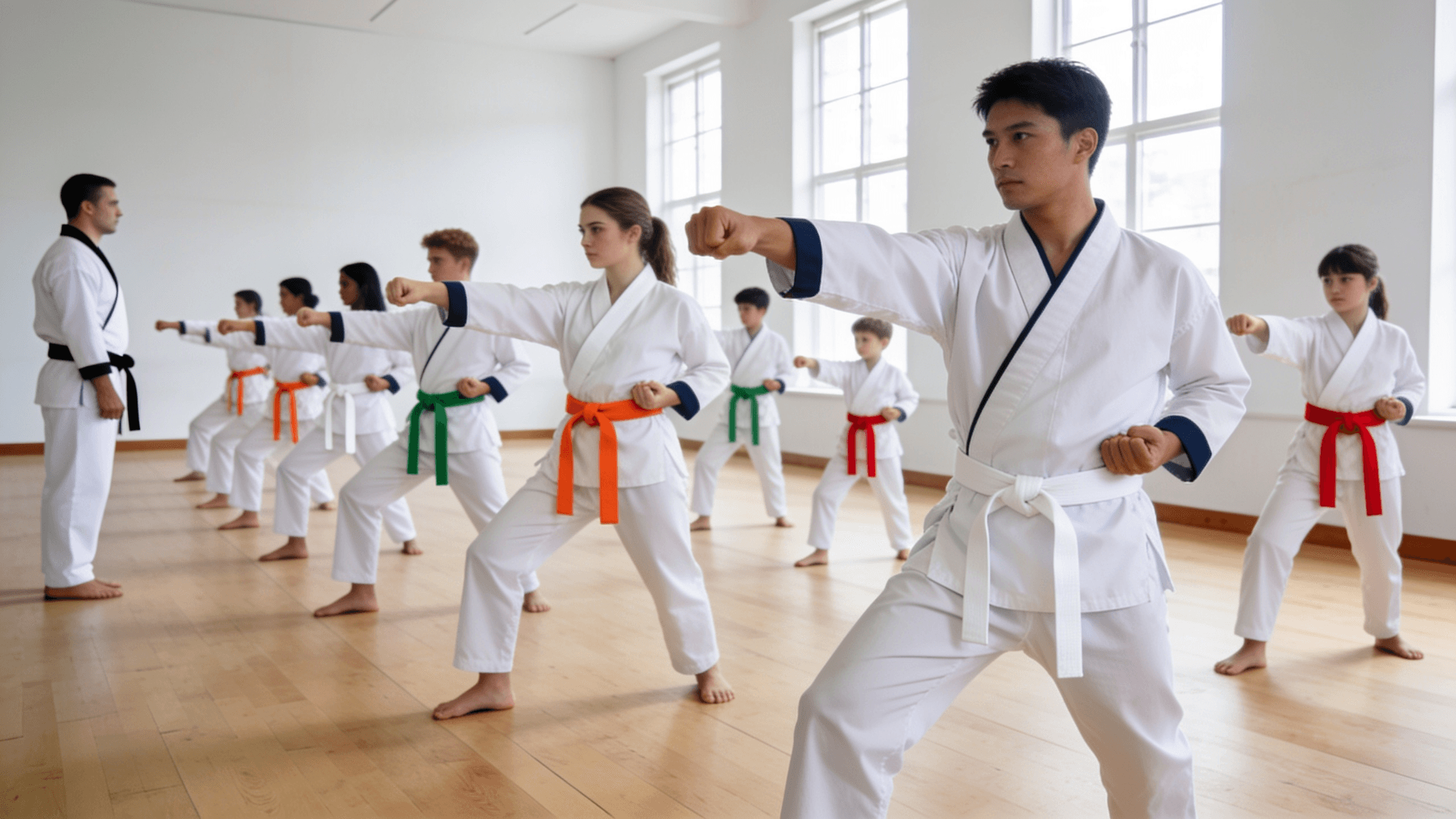
Karate teaches striking, kicking, and blocking through structured forms and partner drills. The basic movements are not physically complex, which is why it is one of the most common martial arts introduced to kids and adult beginners alike.
What makes karate feel approachable early on is that progress is clearly marked. Belt ranks follow a defined curriculum, so you always know what you are working toward. Schools vary a lot in how they train, so look for one with a real beginner curriculum and consistent sparring rather than just forms practice.
Good for
Discipline, structured progression, general striking
Contact level
Low to moderate depending on the school.
Equipment needed
Gi (uniform), optional sparring gear
3. Judo
Judo is a throwing and grappling art built around using your opponent’s momentum against them. The core idea is that leverage and timing beat raw strength, which means beginners do not need to be physically imposing to make the techniques work.
Breakfall training (learning to land safely) is where most classes start, and it is genuinely useful. Once you can fall without getting hurt, the throws themselves become less intimidating to practice. Judo is also an Olympic sport, so competitive pathways are well-established if that interests you.
Good for
Leverage-based self-defense, competition, fitness
Contact level
Moderate. Partner drilling is physical but controlled.
Equipment needed
Gi
4. Muay Thai
Muay Thai is called the art of eight limbs because it uses punches, kicks, elbows, and knees. Despite covering more weapons than boxing, beginners pick it up quickly because the basic strikes are intuitive and classes are usually structured to build fundamentals before adding combinations.
It is one of the more physically demanding options on this list, but that is also part of the appeal. Muay Thai conditioning classes are a real workout even if you never spar competitively. Most gyms offer beginner-friendly sessions where you drill on pads and bags without full contact.
Good for
Striking variety, fitness, combat sports
Contact level
Scalable. Pad work is the norm for beginners.
Equipment needed
Gloves, shin guards, hand wraps
5. Brazilian Jiu-Jitsu (BJJ)
BJJ focuses on controlling an opponent on the ground using leverage, positioning, and submissions. Size and strength matter less here than in striking arts, which makes it genuinely accessible for smaller adults and women looking for practical self-defense skills.
The learning curve in BJJ is steep. Beginners often feel lost in early rolling sessions because there are a lot of positions to learn. But the community tends to be welcoming, and most schools have a structured beginner program. Once fundamentals click, progress feels steady.
Good for
Ground control, self-defense, sport competition
Contact level
Moderate. Rolling (live grappling) is common early on but is typically done cooperatively.
Equipment needed
Gi, or no-gi shorts and rash guard
6. Krav Maga
Krav Maga is a practical self-defense system developed for real-world situations. It does not have a competitive ruleset or a traditional belt ranking system. The techniques are designed to be learned fast and applied under stress, which is why military and law enforcement have adopted versions of it.
Classes focus on scenarios: someone grabs you from behind, someone draws a weapon, someone attacks in a confined space. You do not need prior martial arts experience. What you do need is a school with qualified instructors, since quality varies more in Krav Maga than in more standardized arts like judo or BJJ.
Good for
Practical self-defense, scenario training, no prior experience needed
Contact level
Moderate to high depending on the program.
Equipment needed
Minimal. Comfortable workout clothes, gloves for some drills.
7. Aikido
Aikido uses an opponent’s force and momentum against them through joint locks, throws, and redirection. It was designed to neutralize an attacker without causing serious injury, which gives it a different philosophy than the striking and sport-focused arts on this list.
Aikido is worth considering if you prefer non-competitive training and want to build situational awareness and body mechanics over time. It takes patience. Techniques that look fluid in demonstrations require a lot of repetition to internalize. But for adults who want a low-impact, meditative practice with genuine self-defense application, it offers something the other arts on this list do not.
Good for
Non-competitive practice, joint control, low-impact training
Contact level
Low. Most training is cooperative and controlled.
Equipment needed
Gi
Quick Comparison: Which Is Easiest for Your Goal?
What Makes a Martial Art Easy to Learn?
A martial art feels easy to learn when the first techniques are straightforward, progress is visible early, and classes are structured for beginners. Here are the factors that actually affect how fast you improve:
Simple core skill set. Boxing has four punches. Judo’s first throws use the same mechanical principle. When the foundational moves are repeatable and not too many, beginners can build muscle memory faster.
Good instruction. This matters more than the style itself. A well-run karate school with patient coaches will feel easier than a chaotic BJJ gym that throws beginners into live rolling with no context.
Contact level that matches your comfort. Some styles let you ease into sparring gradually. Others put you in contact situations early. Neither is wrong, but knowing what you are walking into helps you stay consistent rather than dropping out after two sessions.
Low barrier to entry. Equipment costs, class availability near you, and whether a beginner program actually exists at a specific gym all affect how easy it is to just start and keep going.
Easiest Martial Art to Learn at Home
Boxing and karate are the most practical options for home training without a partner. You can work boxing combinations on a bag, shadowbox for footwork and timing, and build real conditioning without a gym. Karate kata (forms) can be practiced solo and help reinforce body mechanics.
Styles that rely on partner drilling, like judo, BJJ, and Muay Thai clinch work, are harder to develop at home because the techniques require resistance and another body to learn properly. You can supplement home training with instructional videos, but these arts need mat time with real partners to develop usable skills.
If you want to train primarily at home, boxing or karate give you the most to work with on your own. Budget for a decent heavy bag if you go the boxing route.
Easiest Martial Art to Learn for Self-Defense
For self-defense specifically, boxing and Krav Maga get beginners to functional skills the fastest. Boxing teaches you to hit, avoid being hit, and manage distance under pressure, all of which are core self-defense competencies. Krav Maga is built entirely around threat response and practical scenarios.
Judo and BJJ are also strong self-defense options because they teach control, not just striking. If a real altercation goes to the ground (which they often do), grappling skills are genuinely useful. The tradeoff is that the learning curve is longer before the techniques feel natural under stress.
The honest answer: any martial art practiced consistently beats no martial art. The best self-defense training is the one you show up to regularly.
Easiest Martial Art to Get a Black Belt In
Karate typically has the most accessible black belt timeline for consistent adult beginners. With regular training (two to three times per week), most students can reach black belt level in three to five years in a traditional karate school. The curriculum is well-defined and progress is transparent.
Judo black belts follow a similar timeline at dedicated clubs. BJJ is generally considered the hardest, with most practitioners taking eight to twelve years to reach black belt, and the belt itself is awarded based on demonstrated ability rather than time or testing alone.
A few things worth knowing: belt systems vary by school even within the same style. A Krav Maga black belt means something different at one organization than at another. And in arts like boxing and Muay Thai, there are no belts at all. Progress is measured by performance, not rank.
How to Choose the Right Martial Art
Define your goal first. Fitness, competition, self-defense, and personal development all point toward different answers. Be honest about what you actually want.
Visit the gym, not just the style. Two schools teaching the same art can feel completely different. A trial class tells you more than any ranking list. Look for structured beginner instruction, a welcoming training culture, and coaches who explain the why behind techniques.
Match your schedule and budget. The easiest martial art to learn is the one you can actually attend consistently. A style you train twice a week will beat a better style you train once a month.
Think about contact level. If you are not ready for sparring, that is fine. Many great programs let you spend months on drilling and bag work before introducing live contact. Ask how the school handles beginner progression before you sign up.
Running a Martial Arts School?
If you own or operate a martial arts school, Spark handles the business side so you can focus on the mat. Membership management, automated billing, attendance tracking, and CRM tools built specifically for martial arts schools. See how Spark works.